
Hello lovely readers! I’m Jan Nishu from ProxyMingle, and after six months of hands-on proxy testing, today’s article covers datacenter proxy providers — a topic many of you have been asking about.
Scraping data feels smooth until an IP gets flagged mid-task. Then everything stalls. Orders fail, accounts freeze, and trust in a proxy service starts to crack.
Most people blame their scraper or automation tool first. The real issue often sits somewhere else entirely — inside the proxy network itself.
Datacenter proxy providers aren’t all built the same way. Speed, IP quality, and detection rates vary sharply between services, and small differences quietly affect daily results.
Marketers, developers, and beginners face this confusion often. Before jumping into any provider, a few overlooked factors deserve real attention. Something worth pausing on.
What Are Datacenter Proxy Providers and How Do They Work?
Datacenter proxy providers offer server-based IP addresses hosted in commercial data centers, not issued by home internet providers. When you connect through one, your traffic passes through a remote server before reaching the target website, masking your real IP address.
These proxies aren’t tied to physical devices or ISPs. Instead, they’re generated in bulk from cloud infrastructure or dedicated hosting facilities, which is why they’re fast, affordable, and easy to scale.
A typical setup works like this:
- Your request goes to the proxy server.
- The proxy forwards it using a datacenter IP.
- The target site responds to the proxy, not to you.
- The proxy relays the response back to your device.
Because datacenter proxies run on high-performance hardware, they typically offer low latency and high concurrency. This makes them well-suited for tasks like web scraping, SEO monitoring, and ad verification, where speed and volume matter.
The tradeoff is detectability. Datacenter IPs are easier for some websites to flag compared to residential IPs, which brings us to the next distinction worth understanding.
Datacenter Proxy Providers vs Residential Proxy Providers: Key Differences
Datacenter proxy providers and residential proxy providers solve different problems, and choosing between them depends on what you’re trying to accomplish.
Datacenter proxies come from servers in data centers. Residential proxies use real IP addresses assigned by ISPs to actual households. This single difference shapes almost everything else.
Here’s how they typically compare:
- Speed: Datacenter proxies are faster, often with sub-100ms response times.
- Cost: Datacenter proxies are usually 5–10x cheaper per GB.
- Detection risk: Residential IPs blend in better with normal traffic.
- Best fit: Datacenter proxies suit SEO tools, market research, and QA testing; residential proxies suit e-commerce or social platforms with strict anti-bot systems.
Websites that actively monitor for automated traffic, such as major retail or social media platforms, tend to flag datacenter ASNs more quickly. Sites with lighter protection rarely notice the difference.
Neither option is universally “better.” The right choice depends on your target site’s defenses, budget, and how much speed matters for your workflow. Understanding this tradeoff sets up the next decision: shared or dedicated IPs.
5 Best Datacenter Proxy Providers Compared (Quick Overview Table)
Datacenter Proxy Providers — Quick Comparison Table
| Proxy Provider | Core Strength | Price Range | Perfect Fit |
| Bright Data | Massive IP network | From $0.9/IP | Enterprise-scale automation |
| Oxylabs | Ultra-fast response time | From $0.7/IP | High-speed scraping tasks |
| Webshare | Free starter plan | From $2.99/month | Budget-friendly beginners |
| IPRoyal | Unlimited bandwidth | From $1.39/proxy | Contract-free flexibility |
| Apify | Built-in automation tools | From $0.6/IP | All-in-one scraping workflows |
1. Bright Data — Datacenter Proxy Provider Spotlight
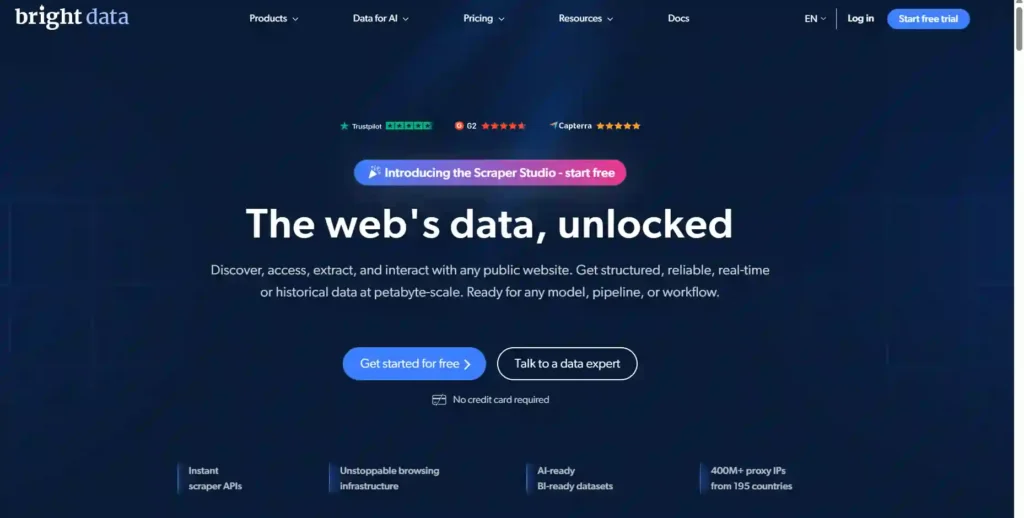
Bright Data leads the datacenter proxy space with a massive, high-speed network built for serious scraping and automation work. If you’ve struggled with slow proxies or constant IP bans, this one changes the game.
With over a million fast IPs and near-perfect uptime, Bright Data handles heavy workloads without breaking a sweat. Teams running large-scale data extraction, SEO tracking, or ad verification consistently rate it among the most reliable options available. It’s built for scale, but flexible enough for smaller projects too.
Key Features:
- Massive IP Pool: Over 1.3M+ datacenter IPs across multiple regions for reliable rotation.
- Enterprise-Grade Speed: Ultra-low latency built for high-volume scraping and automation tasks.
- Ethical Sourcing: Strict KYC compliance ensures clean, trustworthy, and legally sourced IP addresses.
- Full API Access: Seamless integration with existing tools through robust proxy management APIs.
Pricing: Starts from $0.9/IP, with flexible plans scaling based on volume, usage, and project size.
Best For: Enterprise teams needing scale, speed, and dependable uptime.
Limitations:
- Pricing may feel steep for small individual projects
- Initial setup requires some technical familiarity to configure
Rating: ⭐⭐⭐⭐⭐ (4.8/5)
My Experience: Fast, stable, and reliable during heavy scraping sessions — barely any blocks, even on tougher target sites.
Why I Picked It: Consistent performance, strong support, and scalability make it a dependable long-term proxy partner.
2. Oxylabs — Datacenter Proxy Provider Spotlight
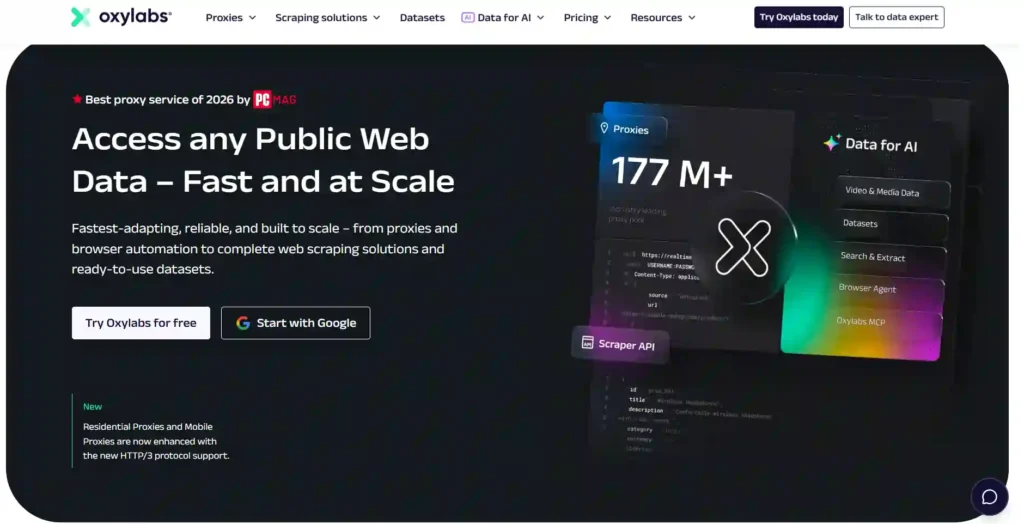
Oxylabs brings serious muscle to datacenter proxies, backed by a 2M+ IP network built for speed and scale. If you’ve dealt with slow response times or shaky uptime elsewhere, this one’s worth a real look.
With a 0.25s average response time and coverage across 188+ countries, Oxylabs handles heavy scraping loads without slowing down. It’s a favorite among SEO platforms, e-commerce teams, and enterprise data operations that need consistent performance day after day.
Key Features:
- Huge IP Network: 2M+ datacenter IPs available across 188+ countries worldwide.
- Lightning-Fast Response: Average 0.25s response time for high-speed scraping tasks.
- Free Trial IPs: Test performance with 5 free datacenter IPs before committing.
- Easy Integration: Simple setup with Python, cURL, Node.js, PHP, and more.
Pricing: Starts from $0.7/IP, with dedicated plans available from $1.2/IP for exclusive use.
Best For: Teams needing fast, large-scale, reliable scraping infrastructure.
Limitations:
- Dedicated plans cost more than basic shared options
- Advanced features may need setup time initially
Rating: ⭐⭐⭐⭐⭐ (4.5/5)
My Experience: Impressively fast and stable, even during high-volume scraping — barely noticed any slowdowns or blocks.
Why I Picked It: Strong global coverage, quick response times, and genuinely helpful documentation for setup.
3. Webshare — Datacenter Proxy Provider Spotlight
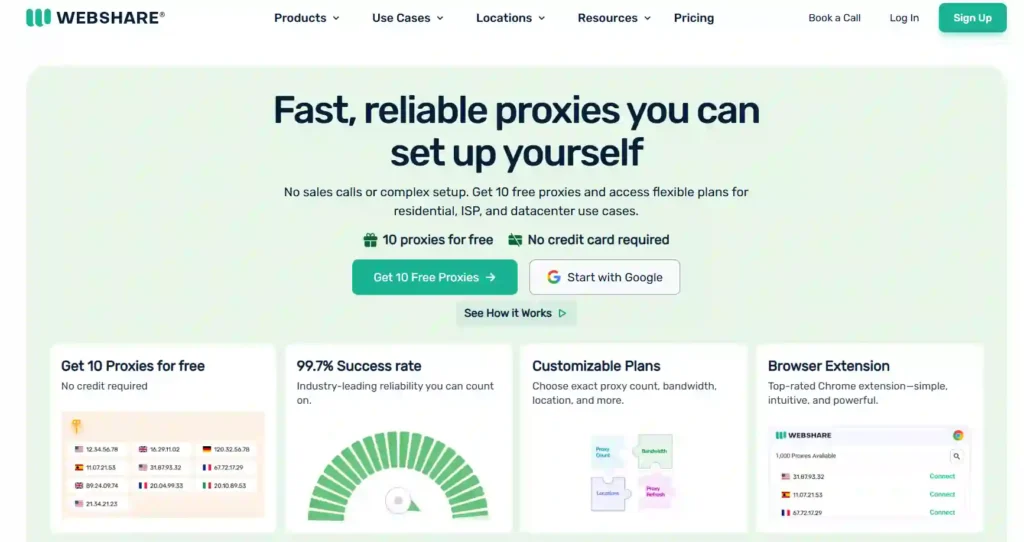
Webshare makes datacenter proxies genuinely accessible, offering 10 free proxies with no credit card required. If you’ve been hesitant to commit before testing real performance, this removes that barrier entirely.
With 80M+ IPs across 195 countries and a self-serve dashboard, Webshare lets you launch proxies instantly without sales calls. It’s a solid pick for smaller teams, freelancers, or anyone scaling gradually while keeping costs predictable.
Key Features:
- Free Starter Plan: 10 free proxies permanently, no credit card or commitment needed.
- High Uptime: 99.97% uptime across 400K+ fast, reliable datacenter IPs.
- Flexible Scaling: Choose exact proxy count, bandwidth, and location per plan.
- Self-Serve Dashboard: Launch, configure, and manage proxies without sales teams.
Pricing: Starts from $2.99/month for 100 proxies, scaling down to $0.0179/proxy at volume.
Best For: Budget-conscious users and teams needing flexible, self-managed scaling.
Limitations:
- Lower entry plans have smaller bandwidth and IP limits.
- Fewer advanced features compared to enterprise-grade providers.
Rating: ⭐⭐⭐⭐☆ (4.3/5)
My Experience: Simple setup and genuinely fast for the price — great starting point without early financial commitment.
Why I Picked It: Free tier, transparent pricing, and easy scaling make it ideal for growing projects.
4. IPRoyal — Datacenter Proxy Provider Spotlight
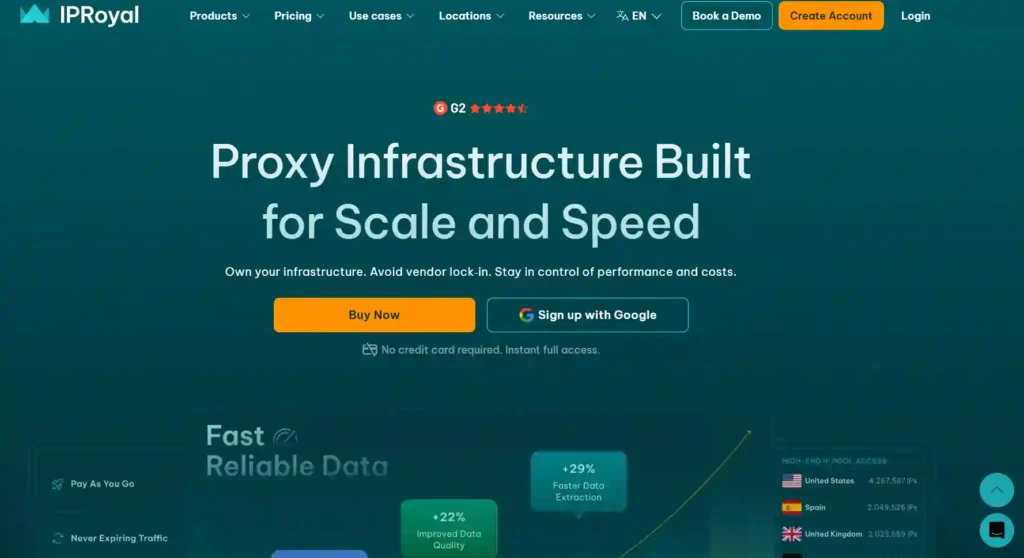
IPRoyal delivers solid datacenter proxy performance with unlimited bandwidth and coverage across 60+ locations. If you’ve been paying per-GB and watching costs spiral, this flat, predictable pricing model is a refreshing change.
Built for speed-critical tasks like scraping, monitoring, and software testing, IPRoyal’s network avoids vendor lock-in while keeping setup straightforward. It’s a strong match for developers and teams who want dependable infrastructure without long-term contracts.
Key Features:
- Unlimited Bandwidth: No data caps on datacenter plans, ideal for heavy workloads.
- Global Coverage: Datacenter proxies available across 60+ countries worldwide.
- No Contracts: Non-expiring traffic and flexible plans with no vendor lock-in.
- Powerful API: 650+ tool integrations with full programmatic ordering support.
Pricing: Starts from $1.39/proxy, with usage-based plans and no hidden fees.
Best For: Developers needing flexible, contract-free datacenter infrastructure.
Limitations:
- Smaller proxy pool compared to enterprise-scale providers.
- Advanced features require some technical setup.
Rating: ⭐⭐⭐⭐☆ (4.4/5)
My Experience: Reliable and refreshingly transparent — no surprise charges, and support responded quickly when I had setup questions.
Why I Picked It: Flat unlimited bandwidth pricing and strong location coverage made scaling simple and predictable.
5. Apify — Datacenter Proxy Provider Spotlight
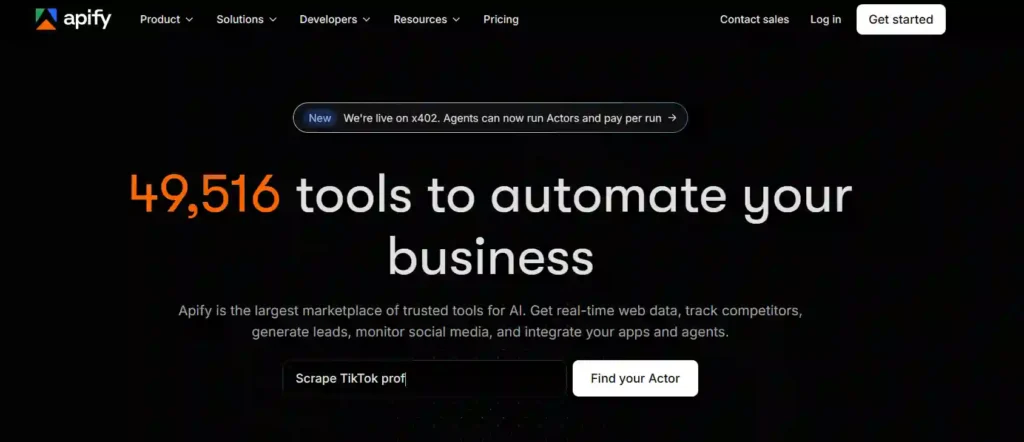
Apify approaches datacenter proxies differently, bundling them directly into a massive automation and scraping platform. If you’ve juggled separate tools for proxies and scrapers, this combo genuinely simplifies your workflow.
With 49,374+ ready-made Actors and built-in proxy rotation, Apify suits developers who want scraping, automation, and proxy infrastructure under one roof. It’s especially useful for teams already building custom data pipelines or AI-driven workflows.
Key Features:
- Built-In Proxy Rotation: Datacenter IPs integrated directly into scraping Actor workflows.
- Massive Actor Marketplace: 49,374+ pre-built tools for scraping, automation, and data.
- Flexible Add-Ons: Pay-as-you-go datacenter proxy pricing scales with usage.
- Enterprise Reliability: 99.95% uptime with SOC2, GDPR, and CCPA compliance.
Pricing: Starts from $0.6/IP, with free plans including 5 datacenter proxy IPs.
Best For: Developers combining scraping automation with proxy infrastructure.
Limitations:
- Pricing structure can feel complex for proxy-only use cases.
- Best suited for technical users comfortable with platform setup.
Rating: ⭐⭐⭐⭐☆ (4.6/5.)
My Experience: Powerful once configured — combining Actors with datacenter proxies streamlined my entire scraping pipeline.
Why I Picked It: All-in-one platform saved time by merging proxy management with ready-made automation tools.
Shared vs Dedicated Datacenter Proxy Providers: Which One Fits Your Use Case?
Once you’ve decided on datacenter proxies, the next choice is whether you need shared or dedicated IPs. This affects reliability, cost, and how much control you have over your IP reputation.
Shared datacenter proxies are used by multiple customers at once. They’re cheaper, but you inherit some risk — if another user gets an IP flagged, it can affect your access too.
Dedicated datacenter proxies assign an IP exclusively to you. Nobody else’s activity influences your IP’s reputation, making them more stable for long-running tasks.
A quick comparison:
- Shared: Lower cost, higher risk of shared blocks, good for light or occasional tasks.
- Dedicated: Higher cost, consistent performance, better for account management or ongoing monitoring.
Shared proxies work well for one-off research, link checks, or small-scale scraping. Dedicated proxies make more sense for businesses running continuous automation, SEO rank tracking, or tasks requiring a stable, trusted IP over time.
There’s no universally correct option here. It depends on volume, budget, and how much consistency your project demands. With that framework in place, here’s how we tested and scored providers for this list.
How We Evaluated the Best Datacenter Proxy Providers (Speed, Uptime, IP Pool)
To recommend datacenter proxy providers with confidence, we evaluated each one against measurable, real-world performance criteria rather than marketing claims.
Our testing focused on the factors that affect actual usability:
- Speed: Average response time across multiple target sites.
- Uptime: Server availability and connection consistency over time.
- IP pool size: Number of available IPs and how frequently they refresh.
- Geo-coverage: Range of countries, states, or cities available for targeting.
- Success rate: Percentage of requests that completed without blocks.
- Pricing transparency: Whether costs are per-GB, per-IP, or bundled with hidden limits
We also considered protocol support (HTTP, HTTPS, SOCKS5), ease of setup, and customer support responsiveness, since these directly impact day-to-day usability.
No single metric tells the full story. A provider with a large IP pool but poor uptime isn’t more useful than one with fewer IPs and consistent performance. That’s why we weighed these factors together rather than ranking on price or pool size alone.
With this evaluation framework in mind, here’s a closer look at the five datacenter proxy providers that stood out.
Frequently Asked Questions — Datacenter Proxy Providers
What is a datacenter proxy provider?
A datacenter proxy provider offers IP addresses hosted in commercial data centers rather than through ISPs. These proxies deliver fast, scalable connections ideal for web scraping, automation, and SEO monitoring tasks.
Are datacenter proxies better than residential proxies?
Datacenter proxies are faster and cheaper, but residential proxies blend in better with real traffic. The right choice depends on your target site’s anti-bot detection and specific use case.
Which datacenter proxy provider is the cheapest?
Webshare offers the most budget-friendly entry point, starting from $2.99/month with a permanent free plan. Pricing scales down further with higher proxy volumes and longer commitments.
Are datacenter proxies legal to use?
Yes, datacenter proxies are generally legal when used responsibly. Compliance depends on respecting website terms of service, data privacy laws, and avoiding unauthorized access to sensitive information.
What’s the difference between shared and dedicated datacenter proxies?
Shared proxies are used by multiple customers, lowering cost but increasing block risk. Dedicated proxies are exclusively yours, offering more stability for long-running scraping or automation tasks.
Do datacenter proxies work well for web scraping?
Yes, datacenter proxies are excellent for web scraping due to their speed and affordability. They work best on lightly protected sites; heavily guarded platforms may require residential proxies instead.
Which datacenter proxy provider offers a free trial?
Webshare and Oxylabs both offer free datacenter proxies to test performance before committing. Bright Data and IPRoyal also provide flexible entry-level plans for smaller initial projects.
Final Thoughts from Jan Nishu
Choosing the right datacenter proxy provider really comes down to your specific needs speed, budget, or scale. From Bright Data’s enterprise power to Webshare’s free-friendly start, each option covers different priorities.
I’ve tested these firsthand, and honestly, there’s no one-size-fits-all winner here. Start with a free trial, compare real performance on your target sites, and scale from there.
If this guide helped, drop your thoughts below, and don’t forget to bookmark ProxyMingle for more honest, hands-on proxy reviews. Your feedback genuinely shapes what I write next!