

Not every scraping tool or automation script works well on shared or datacenter IPs. Sites flag the traffic, block the range, or throttle requests until the project stalls. This is usually the point where teams start looking at ISP proxies instead.
An ISP proxy combines the speed of a datacenter connection with an IP address registered to a real internet service provider, which makes it far less likely to get flagged as proxy traffic. That difference matters for tasks like web scraping, ad verification, or managing multiple accounts, where stability and trust score directly affect results.
Not all providers deliver the same IP quality, network speed, or pricing structure, though. The list below looks at eight ISP proxy providers worth considering, based on what each one offers for different use cases and budgets.
What Are ISP Proxy Providers and How Do They Work?
An ISP proxy provider is a company that leases out IP addresses registered to real Internet Service Providers, then hosts those IPs on datacenter servers instead of home routers. The result is an IP that looks like it belongs to an actual residential user, but runs on infrastructure built for speed and uptime.
This is different from how residential proxies work. A residential proxy routes traffic through someone’s actual home device, which is why it’s slower and less predictable. An ISP proxy skips the home device entirely. The provider partners directly with telecom companies to register blocks of IPs, then assigns them to customers as static, dedicated addresses.
For the end user, this means a fixed IP that doesn’t rotate mid-session, paired with response times closer to a datacenter connection. That combination is why ISP proxies are commonly used for tasks that need both a consistent identity and reliable speed, such as managing accounts, monitoring prices, or tracking search rankings from a specific location.
How We Chose the Best ISP Proxy Providers (Evaluation Criteria)
Not every provider that sells “ISP proxies” delivers the same quality, so we evaluated each one against a consistent set of criteria before including it on this list.
- IP source and legitimacy — Whether IPs are genuinely registered to consumer ISPs, not relabeled datacenter ranges.
- Pool size and coverage — Number of available IPs and how many countries or regions they cover.
- Speed and uptime — Real-world response times and how consistently the connection stays available.
- Session stability — Whether the IP stays static for the duration of a plan, as ISP proxies are meant to.
- Pricing structure — Per-IP, per-GB, or subscription-based, and how that pricing scales with usage.
- Authentication and setup — Support for user:pass and IP whitelisting, plus how easy the dashboard is to use.
- Customer support — Response times and the quality of documentation for troubleshooting.
Providers were only shortlisted if they met a reasonable standard across most of these factors, rather than excelling in just one area while falling short elsewhere.
8 Best ISP Proxy Providers Compared
| Provider | Starting Price | Key Strength | Rating |
| Oxylabs | $1.2/IP | Premium ASN coverage | ★★★★☆ (4.5/5) |
| Webshare | $6/month | Free self-serve setup | ★★★★☆ (4.4/5) |
| Bright Data | $1.3/IP | Compliance-first infrastructure | ★★★★☆ (4.6/5) |
| IPRoyal | $1.80/proxy | Non-expiring traffic | ★★★★☆ (4.4/5) |
| NodeMaven | $2.99/IP | Real-time IP filtering | ★★★★☆ (4.7/5) |
| Decodo | $0.27/IP | Native AI integrations | ★★★★☆ (4.6/5) |
| SOAX | $200/mo | Code-free control plane | ★★★★☆ (4.5/5) |
| ProxyEmpire | $0.75/GB + $2/IP | Unlimited concurrent sessions | ★★★★☆ (4.6/5) |
1. Oxylabs
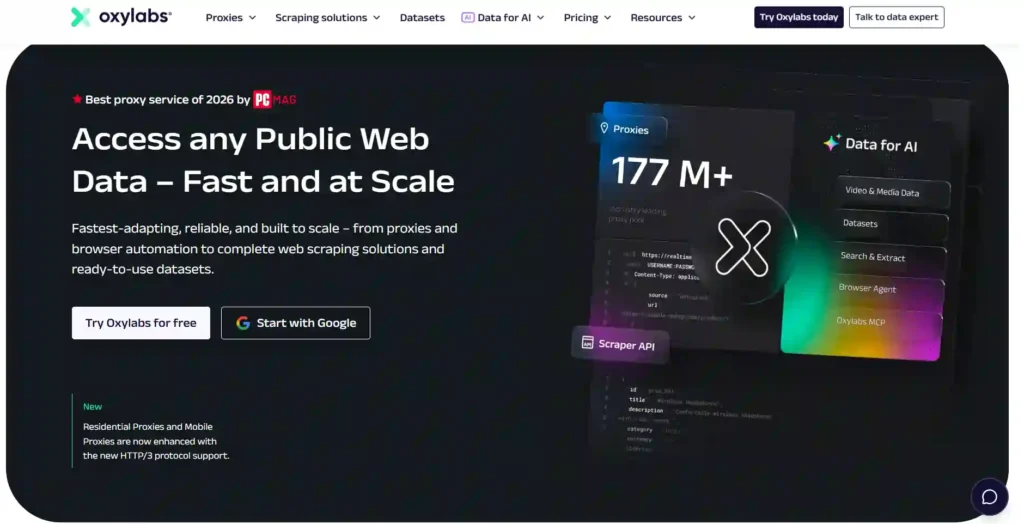
Oxylabs positions its ISP proxies as a solution built for premium ASN coverage and consistently reliable uptime, backed by a proxy network trusted by thousands of businesses worldwide. The provider draws its ISP IPs from partnerships with established telecom operators, giving users addresses that carry genuine residential trust while running on datacenter-grade infrastructure.
For teams handling demanding scraping projects, Oxylabs also offers a dedicated ISP proxy tier, which assigns exclusive IPs rather than shared ones, aimed at users who need consistent performance without sharing bandwidth with other customers.
With unlimited bandwidth on ISP plans and a stated 99.9% uptime commitment, Oxylabs is built for operations where dropped connections or inconsistent speed aren’t an option.
Pros and Cons
Pros:
- Premium ASN-sourced IPs for tough targets.
- Unlimited bandwidth included on ISP plans.
- Dedicated ISP option for exclusive IPs.
- Backed by 99.9% uptime commitment.
Cons:
- Pricing skews higher than budget competitors.
- Enterprise features may exceed small-project needs.
Pricing: ISP proxies start from $1.2/IP; dedicated ISP proxies start from $2.5/IP, with unlimited bandwidth included.
Rating: ★★★★☆ (4.5/5)
Limitations: Entry pricing sits above several budget-focused ISP proxy competitors in the market.
Best for: Businesses running large-scale scraping or data operations that need dependable, high-uptime static IPs from trusted ASNs.
Why we picked Oxylabs: Its dedicated ISP tier and unlimited bandwidth make it a strong fit for demanding, high-volume projects.
2. Webshare
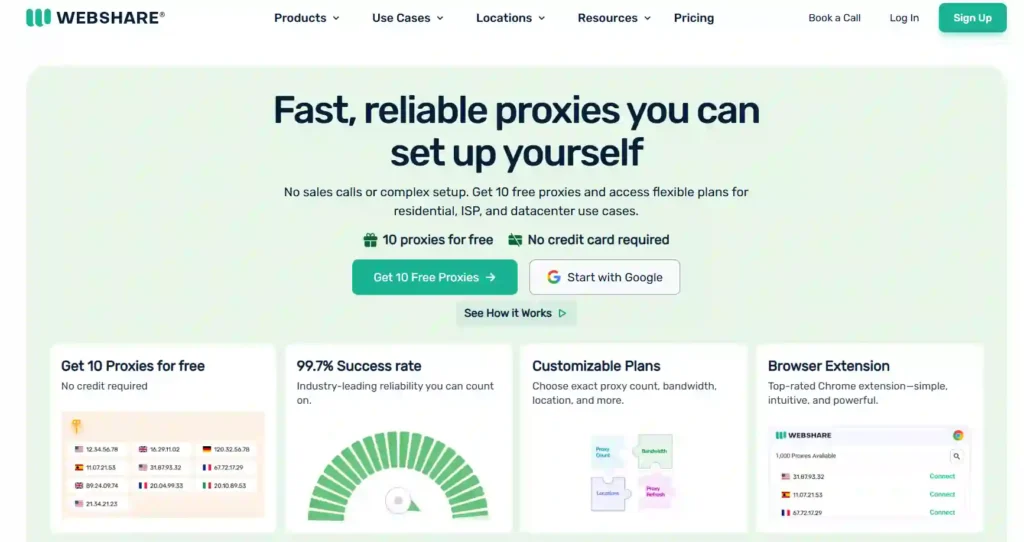
Webshare positions its Static Residential (ISP) proxies as a self-service alternative to sales-heavy proxy providers, letting users get set up in minutes rather than through custom quotes or sales calls. The platform draws its IPs from real ISPs like Comcast and AT&T, giving addresses genuine residential trust while running on infrastructure built for speed.
New users get 10 proxies free with no credit card required, and every plan comes with a self-serve dashboard for managing IPs, bandwidth, and locations. With 80M+ global IPs across 195 countries and filtering down to state, city, or ZIP level, Webshare is built for anyone who wants control without complexity.
Pros and Cons
Pros:
- Free proxies with no credit card.
- Self-service setup, no sales calls.
- ZIP and city-level location targeting.
- 24/7 expert support included.
Cons:
- Free tier limited to 10 proxies.
- Fewer countries than top-tier competitors.
Pricing: Static Residential proxies start from $6/month, with dedicated plans from $2.10/IP billed monthly.
Rating: ★★★★☆ (4.4/5)
Limitations: Bandwidth on entry static residential plans is capped compared to unlimited-tier competitors.
Best for: Developers and small teams who want fast, self-serve access to ISP proxies without enterprise sales friction.
Why we picked Webshare: Its free tier and instant self-service setup make it one of the easiest ways to start using ISP proxies.
3. Bright Data
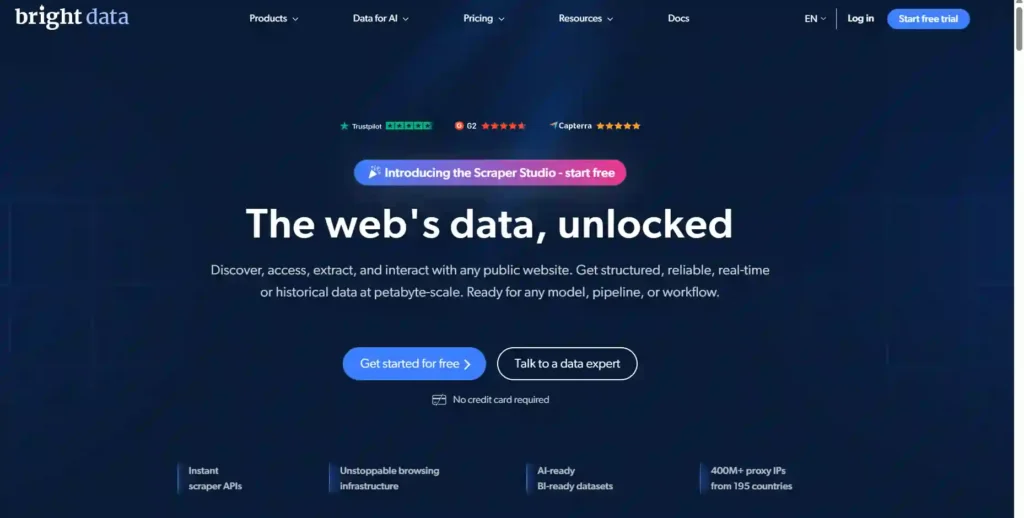
Bright Data brings its ISP proxies into a broader web-data ecosystem that spans scraper APIs, datasets, and browser automation, giving businesses a single platform rather than a standalone proxy tool. Its ISP network offers 1.3M+ static residential-grade IPs, engineered to combine fast connection speeds with the trust of real ISP registration.
Backed by a 99.99% uptime guarantee and a 99.95% success rate, Bright Data positions itself as infrastructure for teams running large, uninterrupted data operations.
The company also emphasizes ethical sourcing, with a dedicated compliance team and adherence to GDPR and CCPA standards, appealing to businesses that need both performance and accountability.
Pros and Cons
Pros:
- 99.99% uptime, 99.95% success rate.
- Ethically sourced, GDPR/CCPA compliant.
- Integrated Proxy Manager included.
- Backed by full scraper API ecosystem.
Cons:
- Higher pricing than budget providers.
- Platform depth can overwhelm beginners.
Pricing: ISP proxies start from $1.3/IP, with residential proxies currently at 50% off from $2.5/GB.
Rating: ★★★★☆ (4.6/5)
Limitations: Full feature set and enterprise tooling may be excessive for small, single-use scraping projects.
Best for: Enterprises and data teams needing compliant, high-uptime ISP proxies alongside scraping infrastructure.
Why we picked Bright Data: Its compliance focus and near-perfect uptime make it a trusted pick for serious, large-scale data operations.
4. IPRoyal
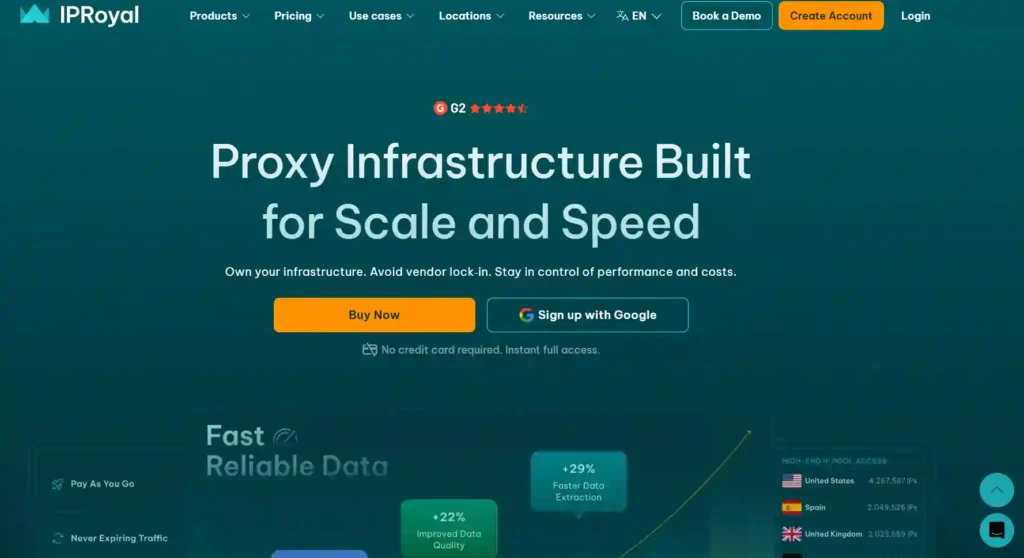
IPRoyal positions its ISP proxies around a simple pitch: datacenter-grade speed paired with residential-level anonymity, sold on a pay-as-you-go model with non-expiring traffic. With a pool of 500K+ unique IPs, the provider targets use cases like ecommerce automation, ad verification, and long-session tasks where reliability matters more than raw scale.
Beyond the proxies themselves, IPRoyal backs its infrastructure with a 99.9% uptime guarantee, city- and state-level geo-targeting, and a full API for programmatic ordering and multi-location management. The platform also supports team-level controls, including workspace permissions and built-in 2FA.
Compliance is a consistent theme throughout IPRoyal’s positioning, with every IP sourced under a strict KYC policy, giving businesses a traceable, accountable proxy network rather than an anonymous IP pool.
Pros and Cons
Pros:
- Non-expiring, pay-as-you-go traffic.
- Datacenter speed, residential anonymity.
- City/state-level geo-targeting available.
- Strong KYC-backed compliance standards.
Cons:
- Smaller ISP pool than top rivals.
- Per-proxy cost adds up at scale.
Pricing: ISP proxies start from $1.80/proxy, billed on a pay-as-you-go basis with no expiring traffic.
Rating: ★★★★☆ (4.4/5)
Limitations: ISP IP pool is notably smaller than providers offering multi-million IP networks.
Best for: Businesses running ecommerce automation, ad verification, or long-session tasks needing predictable, non-expiring proxy costs.
Why we picked IPRoyal: Its non-expiring traffic model and strong compliance backing make it a low-risk, cost-transparent choice.
5. NodeMaven
NodeMaven takes a quality-first approach to ISP proxies, built around static IPs that run 5x faster while maintaining a consistent identity across sessions. Instead of competing on raw pool size, the provider runs an advanced filtering algorithm that screens IPs in real time, addressing an industry problem where 75-99% of unscreened IPs in typical pools end up blacklisted.
That filtering translates into a 95% clean IP rate and sticky sessions lasting up to 24 hours, which matters for account management, multi-accounting, and automation tasks that break when an IP changes mid-session. The platform backs this with a 99.9% uptime guarantee and coverage across 190+ countries with ZIP-level targeting.
NodeMaven also stands out for a usage-based cashback program, returning value on used bandwidth that can be reinvested into future proxy traffic.
Pros and Cons
Pros:
- Real-time IP quality filtering system.
- Sticky sessions up to 24 hours.
- Cashback rewards on usage.
- ZIP-level targeting in 150+ locations.
Cons:
- ISP pricing higher than some rivals.
- Smaller brand recognition than legacy players.
Pricing: ISP proxies start from $2.99/IP, with residential and mobile proxies from $2.20/GB.
Rating: ★★★★☆ (4.7/5)
Limitations: Newer entrant to the ISP proxy market with less enterprise-scale history than established competitors.
Best for: Users prioritizing clean IP reputation and session stability over sheer network size, like multi-account managers and automation teams.
Why we picked NodeMaven: Its quality-first IP filtering directly tackles the blacklisting problem that undermines cheaper proxy pools.
6. Decodo

Decodo, formerly known as Smartproxy, sells its ISP proxies as static residential IPs sourced from premium ASNs, combining residential authenticity with datacenter-like stability. With a network of 125M+ IPs across 195+ countries, the platform offers state-, city-, and ASN-level targeting, backed by a 99.99% uptime commitment and sub-0.2s average speeds.
Beyond raw proxy infrastructure, Decodo bundles its ISP proxies into a broader AI-ready ecosystem, including integrations with n8n, MCP servers, and LangChain, making it a fit for teams building automated data pipelines rather than one-off scraping tasks.
The platform also backs every plan with a 14-day money-back guarantee and free trials, giving newcomers a low-risk way to test static residential proxies before committing.
Pros and Cons
Pros:
- ASN-level targeting for datacenter and ISP.
- 14-day money-back guarantee included.
- Built-in AI and automation integrations.
- Sub-0.2s average response speed.
Cons:
- Entry ISP pricing requires per-IP scaling.
- Brand transition may confuse past users.
Pricing: Static residential (ISP) proxies start from $0.27/IP, among the lowest entry prices in the category.
Rating: ★★★★☆ (4.6/5.)
Limitations: Best value requires scaling IP volume, which can raise total cost for very small projects.
Best for: Teams building AI-ready data pipelines who want static ISP proxies paired with scraping APIs and automation tools.
Why we picked Decodo: Its low entry pricing and native AI integrations make it a strong fit for automated, LLM-driven workflows.
7. SOAX
SOAX offers proxy access built around a control plane where filtering, rotation, and routing rules can all be configured without writing custom scripts. Its network spans 195+ proxy locations, with targeting available down to country, region, city, and ISP level, giving users a way to pin traffic to a specific network provider or geography.
The platform supports HTTP, HTTPS, and SOCKS5 over both TCP and UDP, with flexible authentication through username/password or IP allowlisting, making it adaptable to a wide range of setups and tools.
SOAX’s pricing model is built on credits and tiered network usage rather than flat per-IP rates, which can suit teams that want cost to scale directly with actual traffic volume rather than a fixed proxy count.
Pros and Cons
Pros:
- Full control plane for rules.
- HTTP, HTTPS, and SOCKS5 support.
- ISP-level geo-targeting available.
- 24/7 support on paid plans.
Cons:
- No flat per-IP ISP proxy pricing.
- Credit system adds pricing complexity.
Pricing: Plans start free (Sandbox), with paid tiers from $200/mo, billed by network usage and credits.
Rating: ★★★★☆ (4.5/5, based on user reviews)
Limitations: Pricing structure is usage-tiered rather than simple per-IP, which takes time to model accurately.
Best for: Teams that want granular control over routing, filtering, and rotation rules across a large proxy network.
Why we picked SOAX: Its rebuilt control plane gives technical teams precise, code-free control over request behavior.
8. ProxyEmpire
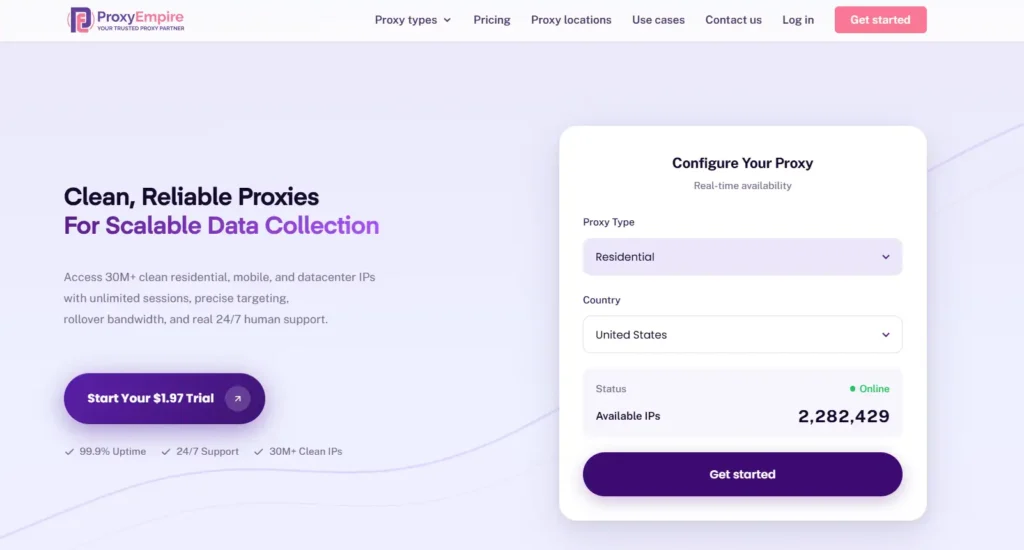
ProxyEmpire’s ISP offering comes in the form of Static Residential proxies, ISP-issued IPs designed to hold the same address over time for workflows that can’t tolerate a shifting identity, such as account access or long-running sessions. These proxies draw from a broader pool of 30M+ clean residential, mobile, and datacenter IPs, backed by a 99.9% uptime commitment and 24/7 human support.
The provider stands out for offering unlimited concurrent sessions, letting teams run multiple monitoring, QA, or scraping workflows at once without session caps slowing things down. It also integrates directly with browser profile tools like Multilogin, Dolphin Anty, and GoLogin.
New users can test the service through a low-cost $1.97 trial before committing to a full plan.
Pros and Cons
Pros:
- Low-cost $1.97 trial available.
- Unlimited concurrent sessions included.
- Integrates with major browser profile tools.
- 24/7 human support, not just bots.
Cons:
- Static IPs priced per GB plus per IP.
- Full ISP pricing needs plan calculation.
Pricing: Static Residential (ISP) proxies start from $0.75/GB plus $2/IP, with volume-based discounts available.
Rating: ★★★★☆ (4.6/5, based on Trustpilot reviews)
Limitations: Combined GB-plus-IP pricing model can make total cost less predictable than flat per-IP plans.
Best for: Teams needing stable, long-session IPs for account access alongside browser-profile tool integrations.
Why we picked ProxyEmpire: Its unlimited sessions and low-barrier trial make it easy to test static IP performance before scaling up.
ISP Proxy Providers vs Residential vs Datacenter Proxies
Each proxy type is built for a different trade-off between speed, cost, and how trustworthy the IP looks to a website.
| Factor | ISP Proxies | Residential Proxies | Datacenter Proxies |
| IP source | Registered to an ISP, hosted on servers | Real home devices | Cloud/hosting providers |
| Speed | Fast | Moderate, varies by device | Fastest |
| IP stability | Static (stays fixed) | Usually rotates | Static |
| Detection risk | Low | Lowest | Highest |
| Typical cost | Mid-range | Highest | Lowest |
| Best suited for | Account management, SEO tracking | Large-scale scraping needing fresh IPs | High-volume tasks where detection risk is low priority |
In short, ISP proxies sit in the middle: they’re not as cheap as datacenter proxies, but they avoid the speed and consistency trade-offs that come with routing through real home connections. Choosing between them usually comes down to whether a task needs raw speed, maximum stealth, or a stable identity that doesn’t change mid-session.
Top Use Cases for ISP Proxy Providers
ISP proxies work best in situations where a task needs to look consistent and trustworthy over time, not just fast.
- Account management — Keeping a stable, dedicated IP per account reduces the risk of platforms flagging logins as suspicious.
- SEO rank tracking — A fixed, location-based IP gives more accurate, repeatable search results from a specific region.
- Price and market monitoring — Static IPs help avoid getting blocked while checking competitor pricing or product listings over time.
- Ad verification — Confirming how ads display in different regions without triggering anti-bot systems.
- Web scraping — Extracting data from sites that actively try to block automated traffic
- Sneaker and limited-release checkouts — Fast, legitimate-looking IPs that hold up during high-traffic release windows.
The common thread across these use cases is that they benefit from an IP that doesn’t change unexpectedly, paired with a connection speed that doesn’t slow the task down.
How to Choose the Right ISP Proxy Provider for Your Needs
The right provider depends less on brand reputation and more on matching a plan to how the proxies will actually be used.
Start with budget and billing model. Per-IP pricing tends to suit steady, predictable workloads like account management, while per-GB pricing usually fits bursty, high-volume scraping better. Paying for the wrong model can quietly double the real cost of a plan.
Next, check geographic coverage. A provider might advertise a large IP pool overall but have limited availability in the specific country or city a project needs, so it’s worth confirming coverage before committing.
Then weigh speed and session stability against the task. Long-running account work depends more on a proxy staying static and reliable, while scraping projects may prioritize raw speed and pool size instead.
Finally, consider support and ease of setup. A provider with clear documentation, straightforward authentication, and responsive support can save significant time, especially for anyone setting up ISP proxies for the first time.
Frequently Asked Questions About ISP Proxy Providers
What is an ISP proxy and how does it work?
An ISP proxy uses IP addresses registered to real internet service providers but hosted on datacenter infrastructure. This gives datacenter speed with residential-level trust scores.
Are ISP proxies better than residential proxies for scraping?
ISP proxies offer faster speeds and unlimited bandwidth compared to residential proxies. They work better for static sessions, but residential proxies rotate IPs more effectively on protected targets.
Do ISP proxies get blocked less than datacenter proxies?
Yes. ISP proxies carry real ISP-assigned addresses, so websites treat them as regular user traffic. Datacenter IPs sit in known hosting ranges and get flagged faster.
What is the difference between shared and dedicated ISP proxies?
Shared ISP proxies split IPs across multiple users, which risks faster bans. Dedicated ISP proxies assign exclusive IPs to one user, giving cleaner reputation and consistent performance.
Can ISP proxies hold the same IP address for long sessions?
Yes. ISP proxies are static by design, holding the same IP across sessions for hours or days. This suits account management, ad verification, and multi-step workflows.
How does ASN quality affect ISP proxy performance?
Premium ASN providers (major telecoms) produce IPs with higher trust scores. Low-quality ASNs get flagged faster because anti-bot systems maintain databases of suspicious IP ranges.
Is unlimited bandwidth standard on ISP proxy plans?
Not always. Some providers include unlimited bandwidth (Oxylabs, IPRoyal), while others cap it per plan tier. Check the per-GB or per-IP billing model before committing.
Jan Nishu’s Take on ISP Proxies in 2026
ISP proxies fill a gap that neither datacenter nor residential IPs can cover alone. Datacenter speed, residential trust, and static sessions in one package. That combination matters when targets are aggressive and sessions can’t afford to break.
Not every provider delivers the same IP quality, though. ASN sourcing, uptime guarantees, and bandwidth caps vary widely. The eight providers above cover different budgets and workloads, so the right pick depends on what you’re actually running.
Test before you commit. Start small, track ban rates, and scale with the provider that holds up under your real traffic.
— Jan Nishu
2 thoughts on “8 Best ISP Proxy Providers 2026: Tested, Ranked & Compared”